
GREENACRES, Fla. — A devastating aviation disaster unfolded in South Florida on Sunday when a private business jet carrying nine people plunged from the sky and crashed into a residential neighborhood, erupting into a massive fireball just feet away from nearby homes and passing vehicles. All nine people aboard the aircraft were killed, according to U.S. Transportation Secretary Sean Duffy.
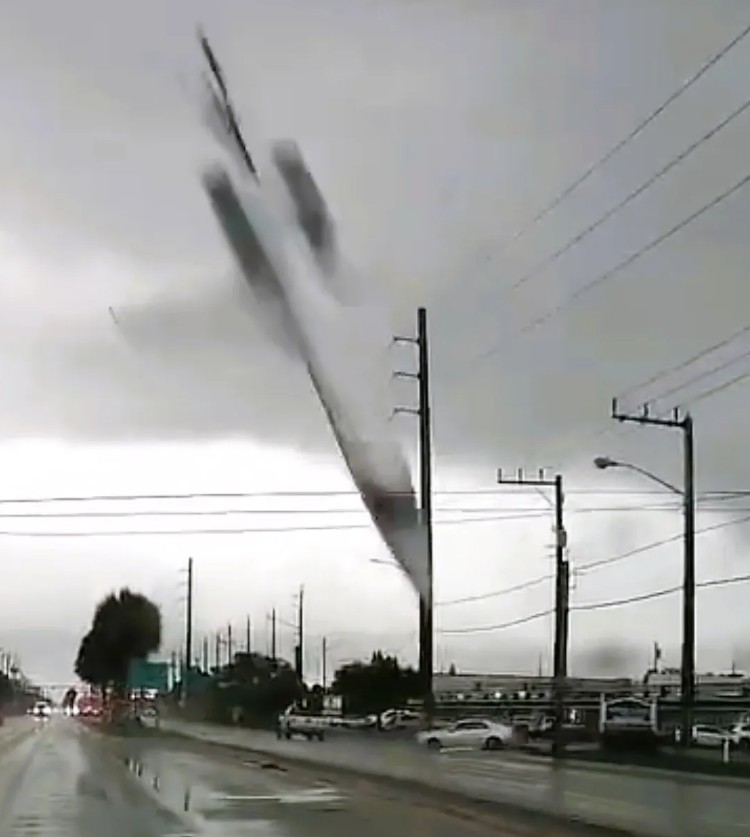
The crash occurred around 12:50 p.m. in Greenacres, a city of approximately 45,000 residents located about seven miles southwest of West Palm Beach in Palm Beach County. The aircraft, identified as a Learjet 60, was traveling from Austin, Texas, to the Bahamas when it suddenly lost control and slammed into the ground near a busy roadway.
Dramatic footage recorded by motorists captured the terrifying final moments of the flight. Videos showed the aircraft descending rapidly from the sky before striking the ground and producing an enormous explosion. A thick column of black smoke quickly rose above the neighborhood, while flames spread across the crash site.
The impact left a large crater near the roadway, with pieces of pavement scattered around the area. Witnesses described a frightening scene, saying the aircraft appeared to fall like a missile before exploding just short of nearby homes.
Despite the extraordinary destruction, Florida officials initially reported no immediate injuries or fatalities among people on the ground.
Transportation Officials Confirm Nine Fatalities and Video
Transportation Secretary Sean Duffy confirmed the tragedy in a statement posted on social media platform X.
Learjet 60 Crash Video and Full Audio
Duffy said the Learjet 60 crashed in Palm Beach County at approximately 12:50 p.m. Sunday, describing the incident as a horrific tragedy. He also announced that the Federal Aviation Administration (FAA) would send a team to assist the National Transportation Safety Board (NTSB) with the investigation.
The confirmation that all nine people aboard had died transformed the incident into one of the region’s most devastating aviation emergencies.
Florida Gov. Ron DeSantis traveled to the crash scene and spoke with reporters about the destruction. He described the aircraft’s descent as extremely violent, comparing its appearance to a missile falling from the sky.
“It was a cataclysmic plane crash,” DeSantis said. “It looked like a missile going down and left a big crater on the side of the road.”
The governor also noted that there were no immediate reports of people on the ground being injured or killed.
For residents and motorists who witnessed the crash, the fact that the aircraft did not strike a nearby house or directly hit passing vehicles appeared almost unbelievable.
Emergency responders quickly secured the area as firefighters worked to contain the flames and authorities began assessing the damage.
Pilot Reported Icing and Severe Turbulence Before the Crash
Preliminary information from air traffic control recordings and flight-tracking data has raised questions about what happened during the aircraft’s final minutes.

According to available information, the Learjet 60 departed Austin-Bergstrom International Airport in Texas and was traveling east toward the Bahamas.
The aircraft had reached an altitude of approximately 35,000 feet, or about 11 kilometers, when the pilots began reporting difficult weather conditions.
The crew communicated with air traffic controllers about turbulence, icing and precipitation affecting the aircraft. The pilot reportedly requested permission to climb another 2,000 feet in an attempt to move away from the worsening conditions.
However, the situation appeared to deteriorate rapidly.
Recordings captured by LiveATC.net indicated that the pilot had reported ice accumulating on the aircraft shortly before the emergency.
“We have light, clear ice that is manageable and moderate turbulence,” the pilot told air traffic controllers.
The pilot also described turbulence powerful enough to cause the aircraft to move vertically by as much as 700 feet, or approximately 213 meters.
Although the initial reports suggested that the conditions were manageable, the aircraft soon began experiencing a dramatic loss of altitude.
Air traffic control recordings revealed increasingly urgent communications from the cockpit as the pilots attempted to regain control.
The aircraft reportedly began descending at approximately 8,000 feet per minute before the descent rate increased to 10,000 feet per minute.
The pilot then issued a distress call.
“We’re descending 8,000 — mayday, mayday — we’re descending 10,000 feet per minute,” the pilot radioed.
The situation continued to worsen. The aircraft’s descent reportedly accelerated to 20,000 feet per minute, eventually reaching approximately 30,000 feet per minute, according to flight-tracking information.
At one point, the pilot reported that the jet had entered an overspeed condition, meaning its speed had exceeded the aircraft’s permitted operating limits.
“We are in an overspeed condition descending 20,000 feet per minute,” the pilot said.
The cockpit communications then captured a heartbreaking acknowledgment of the danger facing the crew.
“We’re going to crash into the ground.”
Moments later, the aircraft banked sharply to the right before striking the ground and exploding.
Severe Weather May Have Played a Role
Weather conditions across South Florida were particularly challenging on Sunday, with heavy rain affecting the region throughout the day.
The National Weather Service had issued a flood watch because of excessive rainfall, which was expected to remain in effect through Monday afternoon.
Investigators will examine whether the weather contributed to the accident, particularly the combination of icing, precipitation and turbulence reported by the pilots.
Aviation safety expert Steve Arroyo said icing and turbulence could have been significant factors in the crash.
One possibility is that ice accumulation affected the aircraft’s aerodynamic performance, potentially contributing to a stall while the jet was cruising at approximately 34,000 feet, or 10,363 meters.
Aircraft icing can be dangerous because ice forming on wings and other critical surfaces can disrupt airflow, increase drag and reduce lift. Under certain circumstances, even relatively limited ice accumulation can affect an aircraft’s ability to maintain stable flight.
Severe turbulence can also make controlling an aircraft more difficult, particularly when combined with challenging weather conditions.
However, aviation experts have emphasized that it is too early to determine whether icing or turbulence directly caused the disaster.
Arroyo noted that investigators would need to consider multiple possible factors, including the weather conditions, the aircraft’s mechanical systems and the pilots’ responses to the emergency.
The NTSB will also examine the aircraft’s flight data, cockpit communications and other available evidence to reconstruct the final moments of the flight.
At this stage, authorities have not announced an official cause.
Private Aircraft Departed Austin for the Bahamas
Jim Reynolds, a spokesperson for Austin-Bergstrom International Airport, confirmed that the aircraft involved was a private jet.
He said the plane had departed the Texas airport before beginning its journey toward the Bahamas.
However, airport officials were unable to immediately provide additional information about the passengers or their identities.
Authorities have not publicly released the names of the nine people who died.
The Learjet 60 is a business jet commonly used for private and corporate travel. It is designed to operate at high altitudes and travel at relatively high speeds, making it suitable for longer-distance flights.
The aircraft’s involvement in the accident has placed renewed attention on the challenges private aviation operators face when dealing with rapidly changing weather conditions.
Investigators will likely examine maintenance records, aircraft history, operational procedures and weather information as part of their efforts to determine what went wrong.
Hundreds of Residents Evacuated Near the Crash Site
The crash also triggered a major emergency response in the surrounding community.
Palm Beach County authorities began evacuating approximately 600 people from a nearby mobile home community while federal investigators prepared to examine the wreckage.
Officials said the evacuation was necessary to protect residents while emergency personnel secured the crash site and assessed potential hazards.
The road near the impact area was closed until further notice, creating disruptions for motorists and local residents.
The presence of burning wreckage, damaged pavement and potentially hazardous aircraft materials made securing the area a priority.
Emergency crews continued working around the crash site as thick smoke and flames highlighted the severity of the impact.
For residents of Greenacres, the incident was particularly frightening because the aircraft came down in a populated area rather than an isolated location.
Witnesses who saw the plane fall described an enormous explosion and a scene of widespread confusion immediately afterward.
The aircraft’s impact near homes and a busy roadway raised serious concerns about how much worse the disaster could have been if its trajectory had been slightly different.
NTSB Investigation Expected to Examine Every Possible Factor
The National Transportation Safety Board announced that investigators were expected to arrive at the crash site on Sunday and Monday.
A media briefing was scheduled for Monday in West Palm Beach, where officials were expected to provide additional information about the investigation.
The NTSB will lead the investigation with assistance from the FAA and other relevant authorities.
Investigators typically examine several aspects of an aviation accident, including aircraft maintenance records, engine performance, flight-control systems, weather conditions, pilot qualifications and air traffic control communications.
They will also attempt to reconstruct the aircraft’s movements using radar information, flight-tracking data and any available onboard recording devices.
The pilot’s reports of icing and turbulence will be particularly important because they provide a timeline of the difficulties encountered before the crash.
Investigators will need to determine whether the aircraft experienced a mechanical malfunction, an aerodynamic problem, a loss of control caused by weather conditions or a combination of several factors.
The steep descent and reported overspeed condition will also receive close attention.
Although the available recordings provide a troubling account of the final minutes, officials have cautioned against drawing conclusions before the investigation is complete.
Determining the precise sequence of events may take considerable time.
A Devastating Disaster That Could Have Been Even Worse
The Greenacres crash has left nine people dead and shocked a South Florida community that narrowly avoided an even greater catastrophe.
A private aircraft carrying nine people fell from cruising altitude, plunged toward a residential neighborhood and exploded near a busy roadway.
While the loss of everyone aboard represents an enormous tragedy, the absence of immediately reported casualties on the ground offered a small measure of relief amid the destruction.
The investigation now turns to understanding why the Learjet 60 entered such a rapid descent and whether the severe weather conditions played a decisive role.
As federal authorities examine the wreckage and review the pilots’ final communications, families of the victims and residents of Greenacres await answers.
For now, the cause of the crash remains unknown. The NTSB’s findings will be essential in establishing what happened during the aircraft’s final moments and whether additional safety measures could help prevent a similar disaster in the future.