
For more than a decade, the images of 12-year-old Palestinian boy Mohammed al-Durrah crouching beside his father at a Gaza junction have remained among the most recognizable and controversial images of the Israeli-Palestinian conflict. Broadcast around the world in September 2000, the footage appeared to show a father desperately attempting to protect his son during a firefight between Palestinian gunmen and Israeli soldiers.
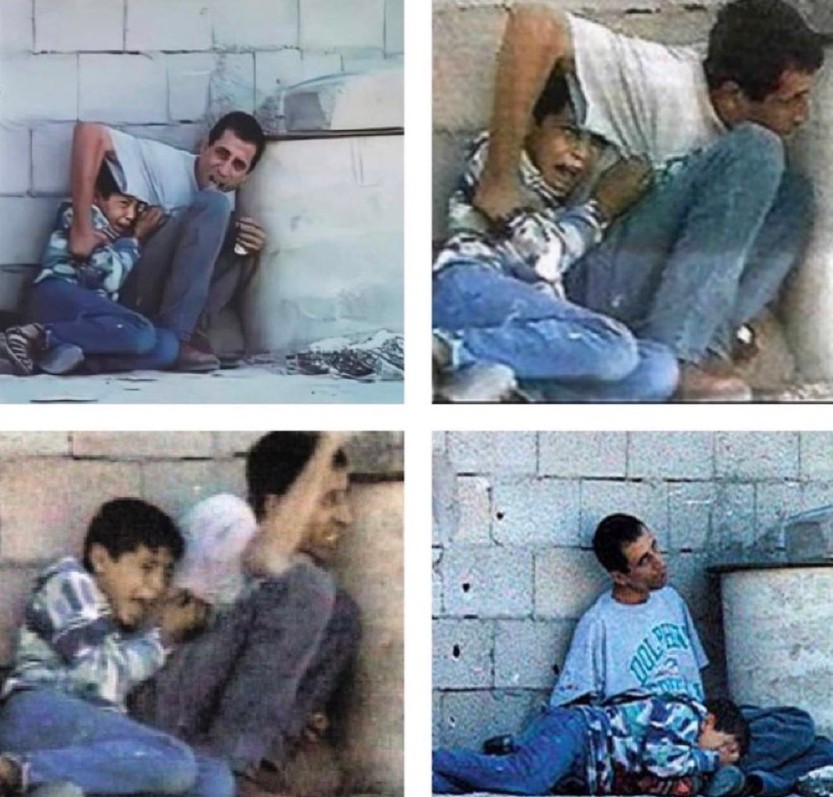
Mohammed appeared to collapse moments later. The report broadcast by France 2 presented the scene as the shooting and death of the child, an event that quickly became a powerful symbol of the Second Intifada.
But an Israeli government investigation later challenged almost every central element of that interpretation. The investigation concluded that there was no evidence the Israel Defense Forces, or IDF, had caused the alleged injuries and disputed the claim that Mohammed had been killed at the scene. It also questioned the testimony of freelance cameraman Talal Abu Rahma and drew attention to portions of footage that were not broadcast.
The findings transformed an already controversial incident into an even deeper dispute over journalism, evidence and competing narratives.
The Incident That Shocked the World and Video
The incident occurred at Netzarim Junction in Gaza in September 2000, only days after the beginning of the Palestinian uprising that became known as the Second Intifada.
Muhammad Al Durrah Video
Jamal al-Durrah and his son Mohammed were caught in the middle of an intense exchange of gunfire. France 2 cameraman Talal Abu Rahma recorded the scene as the father and son sought protection behind a concrete structure and a wall.
The footage showed Jamal trying to shield Mohammed with his body. They remained trapped under fire for an extended period, while bullets appeared to strike the surrounding area.
Eventually, Mohammed appeared to slump against his father. Jamal was also shown apparently wounded.
The images were broadcast internationally and rapidly became a defining visual representation of the violence. For Palestinians, Mohammed became a symbol of civilian suffering and the consequences of the conflict. The footage also generated widespread criticism of Israel and the IDF.
At the time, Israeli officials reportedly acknowledged that the bullets may have come from Israeli positions and described the circumstances as part of the confusion and uncertainty of a battlefield.
That position would later become the subject of intense dispute.
The Israeli Investigation Challenges the Original Account
Years later, an Israeli government investigation reached a dramatically different conclusion.
The inquiry was ordered by Prime Minister Benjamin Netanyahu and led by Moshe Ya’alon, then Strategic Affairs Minister and a former IDF chief of staff. The resulting 44-page dossier argued that the France 2 report did not establish that Israeli soldiers had killed Mohammed or wounded his father.
According to the investigation, there was no evidence that the IDF was responsible for the injuries described in the original report.
One of the most important claims concerned the original, unbroadcast footage.
Investigators said that the final portion of the raw recording showed Mohammed moving his hand. Because those images were not included in the France 2 broadcast, the committee argued that the television report created a misleading impression that the boy had been killed.
The investigation also emphasized that viewers never actually saw Mohammed being struck by a bullet.
The report therefore questioned whether the footage itself could establish how Mohammed was injured or whether he died at the scene.
Questions About Talal Abu Rahma’s Testimony
The Israeli investigation also directly challenged the testimony of Abu Rahma, the freelance cameraman who filmed the incident.
During an investigation conducted approximately one month after the shooting, Abu Rahma stated that he believed Mohammed had been deliberately shot by Israeli soldiers and that his father had also been wounded.
The Israeli committee rejected that account, describing his testimony as containing contradictions, inconsistencies and alleged falsehoods.
The issue became particularly significant because Abu Rahma was one of the few people whose testimony could potentially explain what happened beyond what viewers could see in the edited television report.
The Israeli investigation argued that the material available to France 2 did not support the broadcaster’s central conclusions.
However, supporters of the original account disputed that interpretation and continued to argue that the footage was authentic and accurately reflected the incident.
Netanyahu Calls the Affair a Major Attack on Israel’s Reputation
The controversy also acquired a significant political dimension.
Netanyahu argued that the al-Durrah affair had damaged Israel’s international reputation and described it as part of what he characterized as a broader campaign to delegitimize Israel.
Yuval Steinitz, who served as Strategic Affairs Minister, similarly described the affair as a “blood libel” against Israel and rejected the France 2 report as baseless.
Those statements reflected the Israeli government’s interpretation of the investigation and its significance.
For critics of the investigation, however, the fact that the inquiry was conducted by an Israeli government-appointed committee immediately raised questions about its independence.
Jamal al-Durrah Rejects the Findings
Jamal al-Durrah strongly rejected the Israeli investigation.
He continued to maintain that his son had been killed at the scene and questioned whether Israel would agree to an independent international investigation.
The father also pointed to the destruction of structures around Netzarim Junction, arguing that the demolition of the physical location made it more difficult to reconstruct what happened.
For Jamal, the central issue was not the interpretation of a television report but the physical evidence surrounding his son’s death.
He also expressed willingness to have Mohammed’s body exhumed so that forensic specialists could examine it.
That proposal became one of the most important unresolved aspects of the controversy.
France 2 Defends Its Reporting
France 2 and Charles Enderlin, the network’s Jerusalem bureau chief who compiled the original report, rejected the accusation that the footage had been staged.
Enderlin maintained that the footage was authentic and defended the reporting process.
France 2 also said it was prepared to cooperate with an independent investigation conducted according to international standards.
The broadcaster went further by indicating that it was willing to assist Jamal al-Durrah with an exhumation of Mohammed’s remains.
A pathological examination, potentially including DNA testing, could theoretically help determine whether the remains belonged to Mohammed and provide additional evidence concerning the circumstances of his death.
Enderlin questioned why the Israeli committee had not, in his account, directly approached France 2 or Jamal al-Durrah during its investigation.
He argued that the absence of such participation raised questions about the scope and independence of the inquiry.
Philippe Karsenty’s Longstanding Challenge
Another major figure in the controversy is Philippe Karsenty, a French pro-Israel activist and founder of Media-Ratings.
Karsenty had long accused France 2 of presenting staged or misleading footage. His claims eventually became part of a legal dispute in France involving the broadcaster.
Karsenty argued that the images did not demonstrate that Mohammed had been killed by Israeli forces and maintained that the broadcast was a hoax.
His position broadly aligned with the Israeli investigation’s challenge to the original interpretation, although Karsenty also acknowledged that the Israeli government report itself could not be regarded as entirely impartial.
The French legal proceedings added another layer to an already complicated dispute involving journalism, politics and competing interpretations of visual evidence.
The Evidence at the Center of the Dispute
At the heart of the al-Durrah controversy are several questions that remain sharply contested.
What exactly happened during the gunfire at Netzarim Junction?
Who fired the bullets that struck the area where Jamal and Mohammed were sheltering?
Was Mohammed actually hit by gunfire?
If he was injured, what caused the injuries?
Did he die at the scene?
What happened to the original footage recorded by Abu Rahma?
And did the editing of the France 2 report change the meaning of what viewers saw?
The Israeli investigation answered these questions differently from the original France 2 report and from Jamal al-Durrah’s account.
Yet the competing sides have continued to dispute the reliability and interpretation of the available evidence.
Why the Controversy Continues
The Mohammed al-Durrah case has survived for years because it represents more than a disagreement over one television report.
It illustrates the enormous power of images during wartime. A few seconds of footage can influence international public opinion, become a political symbol and shape perceptions of an entire conflict.
At the same time, the case demonstrates the difficulty of independently verifying events that occur in active combat zones.
For critics of France 2, the missing footage and disputed testimony raise fundamental questions about the original report. For France 2 and Enderlin, the footage remains authentic and the accusations against it represent an attempt to undermine legitimate journalism.
Jamal al-Durrah’s willingness to consider exhuming his son’s body has also kept the focus on the possibility of forensic evidence rather than competing political narratives.
Ultimately, the al-Durrah affair remains defined by sharply conflicting accounts. The Israeli investigation challenged the conclusion that Mohammed was killed by Israeli forces, while his father and France 2 continued to defend the original account.
More than questions of politics or reputation, the central issue remains evidentiary: what can independently verified footage, forensic examination, ballistic evidence and other surviving records establish about what happened that day?
Until those questions are conclusively resolved through evidence acce